
Primate Safaris
Contact us
T : +256 392 159 498
T : +9 1 9544 666 665
E : info@primatesafaris.com

Primate Safaris
Contact us
T : +256 392 159 498
T : +1 (928) 607 1653
E : info@primatesafaris.com
National Park
Ankarafantsika National Park
About the Park
Ankarafantsika National Park is one of Madagascar's protected areas with vast dry deciduous forests, scenic lakes, dramatic sandstone formations and exceptional wildlife situated in the country's northwestern Boeny Region inhabiting many endemic species i.e rare lemurs, birds, reptiles and plants found nowhere else on Earth. Its name, "Ankarafantsika," comes from the Malagasy language and roughly means "the mountain of thorns," reflecting the rugged landscape and distinctive vegetation.
Although it is less visited than Madagascar's rainforest parks, Ankarafantsika is regarded as one of the island's finest destinations for birdwatching, wildlife observation and nature photography including dry forests, wetlands and lakes creating a rich mosaic of habitats that supports remarkable biodiversity.
 Ankarafantsika National Park lies about 115 kilometers southeast of Mahajanga (Majunga) along Madagascar's National Road 4 (RN4), making it relatively accessible from both Mahajanga and Antananarivo covering approximately 136,500 hectares (1,365 square kilometers) stretching between the Betsiboka River to the west and the Mahajamba River to the east. The Park includes Dry deciduous forests, Open woodlands, Tree savannas, Sandstone plateaus, Deep erosion canyons (known locally as lavaka), Permanent lakes, Seasonal streams, Rolling hills.
Climate of the Park
Ankarafantsika experiences a tropical dry climate with distinct wet and dry season that happens in the months of May to October, November to April with average temperatures ranging from 20°C to 35°C and annual rainfall of 1,000–1,500 mm. The dry season is generally the best time for wildlife viewing and hiking because roads and trails are easier to access.
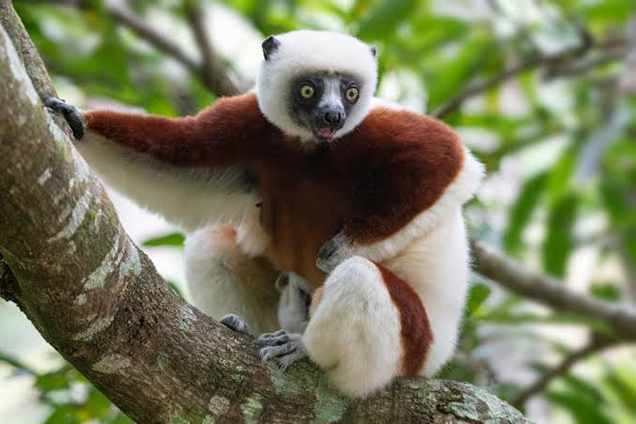
The Park inhabits Lemurs i.e Coquerel's sifaka, Mongoose lemur, Common brown lemur, Western avahi (woolly lemur), Grey mouse lemur, Golden-brown mouse lemur as well as bird species i.e Van Dam's vanga, Schlegel's asity, Madagascar fish eagle, Madagascar heron, Rufous vanga, Banded kestrel. There are reptiles i.e
Rhinoceros chameleon, Dwarf chameleons, Leaf-tailed geckos, Malagasy big-headed turtle, Ground boas, Endemic snakes.
Mammals
Besides lemurs, Ankarafantsika is notable for the greater big-footed mouse, a rodent known only from the park and its surrounding area. Other mammals include fossas, tenrecs, bats, and small carnivores. Flora in the Park includes; more than 800 plant species i.e Dry deciduous forest trees, Baobabs, Palisander (rosewood relatives), Medicinal plants such as Cedrelopsis grevei, Lianas, Shrubs, Seasonal wildflowers.
Best time to visit Ankarafantsika National Park
Ankarafantsika National Park can be visited throughout the year although the best time to visit the park is during the dry season in the months of April to October. The wet season is during the months of November to March. The Dry Season in April to October is ideal since the weather is cooler, rainfall is minimal and hiking trails are easier to navigate. The temperatures are pleasant with lower humidity, dry, well-maintained hiking trails, Excellent conditions for wildlife photography, Easier access to viewpoints and canyons, Comfortable camping and outdoor activities.
What You Can Do Here
Gallery
Swipe to browse · tap to enlarge