
Primate Safaris
Contact us
T : +256 392 159 498
T : +9 1 9544 666 665
E : info@primatesafaris.com

Primate Safaris
Contact us
T : +256 392 159 498
T : +1 (928) 607 1653
E : info@primatesafaris.com
National Park
Nyungwe Forest National Park
About the Park
Fifty meters. That is how high the canopy walkway takes you, suspended above one of the oldest rainforests in Africa, the treetops spreading in every direction as far as you can see, birdsong coming from somewhere below and somewhere above and somewhere you cannot quite locate, the forest floor invisible beneath a layered ceiling of green that has been growing, uninterrupted, since the Ice Age.
Take a moment up there. Look out. Breathe.
You are standing above a forest that survived the Ice Age. While glaciers swallowed most of Africa's vegetation, Nyungwe stayed green, a biological refuge that sheltered thousands of species through millennia of planetary upheaval. What emerged on the other side was one of the most species-rich mountain forests on the entire continent. And it is all still here, in southwestern Rwanda, waiting for you to walk into it.
 Nyungwe Forest National Park covers 980 square kilometers of montane rainforest, bamboo, grassland, swamp, and bog along the spine of the Congo-Nile divide. Stand in the right spot and rainfall on your left flows west into the Congo River.
Rainfall on your right flows east toward the Nile. Researchers believe the headwaters of the world's longest river, the furthest source of the Nile, lie within this forest. There is something quietly extraordinary about standing at a place where the water beneath your feet is already beginning a journey of thousands of kilometers.
But you are not here for the geography alone. You are here for what lives in these trees.
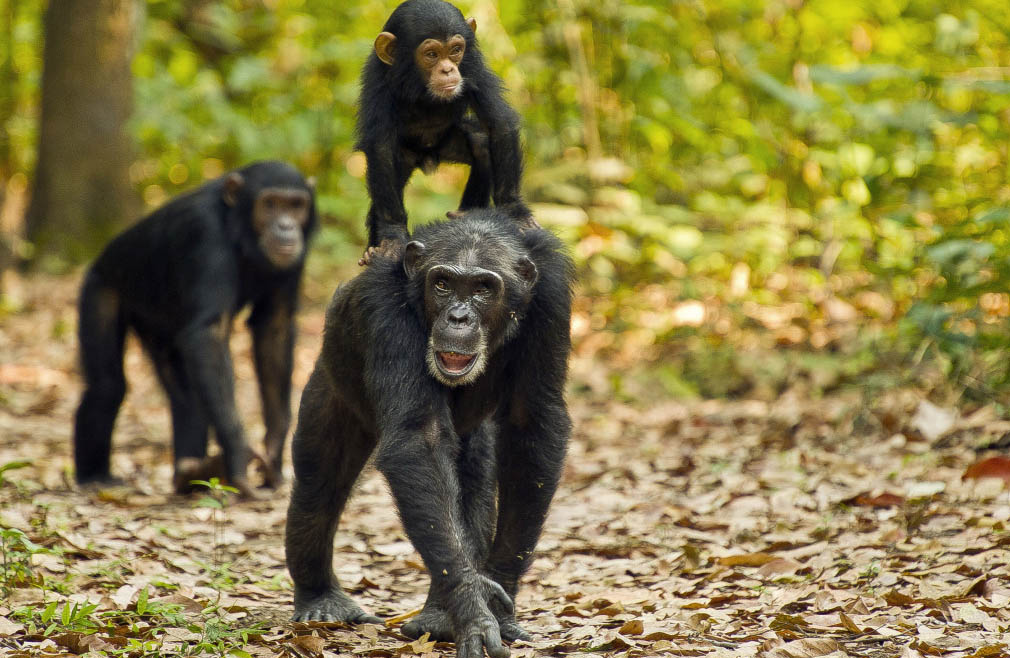
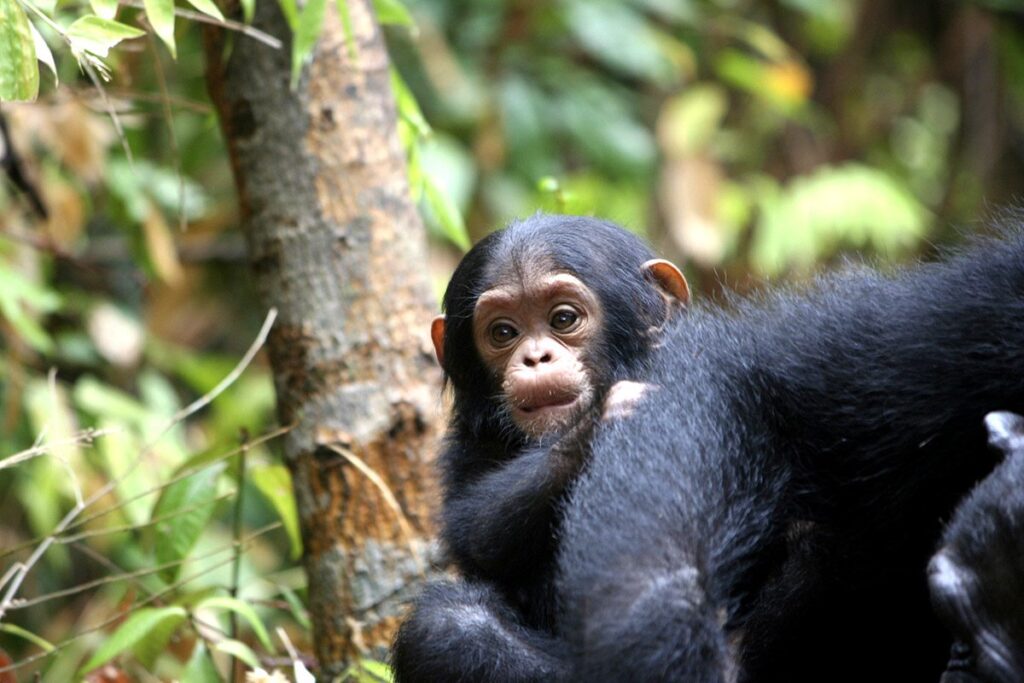 Nyungwe holds 13 primate species, the highest concentration of primates in any park in East Africa. Chimpanzee trekking here is exceptional, with habituated communities moving through the forest in large, vocal, utterly captivating groups.
But it is the colobus monkeys that produce Nyungwe's most jaw-dropping moment, troops of Ruwenzori colobus numbering up to 400 individuals, their black and white capes flashing through the canopy in a coordinated, acrobatic spectacle unlike anything else in Africa. L'Hoest's monkey, the grey-cheeked mangabey, the owl-faced monkey, the blue monkey. This forest is a primate lover's paradise of extraordinary depth and variety.
Over 300 bird species fill every altitude zone, 29 of them endemic to the Albertine Rift and found nowhere else on earth. The Rwenzori turaco burns vivid and improbable through the mid-canopy. The red-collared mountain babbler, Doherty's bushshrike, the yellow-eyed black flycatcher species that serious birders travel across continents to find, all present in a single forest that rewards patience with sightings of almost embarrassing richness.
And then there is the canopy walk itself. Suspended 50 meters above the forest floor on a series of walkways and platforms, it offers a perspective on the rainforest that few experiences in Africa can match, eye level with the canopy, the forest stretching endlessly in every direction, monkeys moving through the branches beside you, the silence broken only by wind and birdsong.
Nyungwe is not Volcanoes. It will not give you a silverback at close range or a moment you can describe in one dramatic sentence. What it gives you is something slower, deeper, and in its own way just as unforgettable as the feeling of being inside one of Africa's last great ancient forests, surrounded by life that has been here far longer than any of us, and will be here long after we are gone.
Wildlife
- Vulture
- African Fish Eagle
- Crowned Crane
- Bushbuck
- Baboon
- Vervet Monkey
- Colobus Monkey
- Caracal
- African Civet
- Chameleon
- Monitor Lizard
- Python
- Bushpig
- Galago (bushbaby)
- Lilac-breasted Roller
- Kingfisher
- Weaver Bird