
Primate Safaris
Contact us
T : +256 392 159 498
T : +9 1 9544 666 665
E : info@primatesafaris.com

Primate Safaris
Contact us
T : +256 392 159 498
T : +1 (928) 607 1653
E : info@primatesafaris.com
National Park
Volcanoes National Park
About the Park
She came here in 1967, climbed into the mist-covered mountains of northwestern Rwanda, and changed the way the world thought about gorillas forever.
Dian Fossey chose these volcanoes. And the gorillas she devoted herself to protecting, and ultimately gave her life to protect, are still here. Thriving. Their numbers are growing. Their families carry the names she gave them, tracked by rangers who continue a mission she started in a small cabin on a misty mountainside that the whole world has since heard of.
To walk into Volcanoes National Park is to walk into one of the greatest conservation stories ever told. And then to walk a little further and come face to face with the story itself.
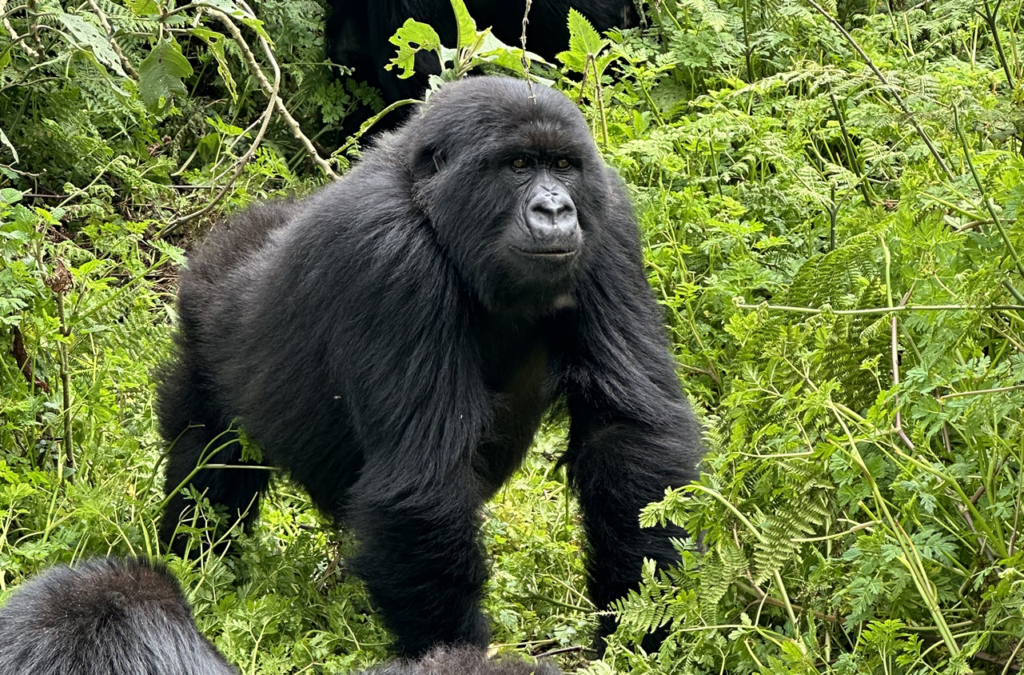 Rwanda's crown jewel sits in the northwest of the country, cradled within the magnificent Virunga Mountains, a chain of ancient volcanoes shared between Rwanda, Uganda, and the Democratic Republic of Congo. Five volcanoes rise within the park's borders: Karisimbi, Bisoke, Muhabura, Gahinga, and Sabyinyo, their peaks draped in forest and cloud, their slopes holding one of the most precious concentrations of life on earth. At 160 square kilometers, Volcanoes is not a large park. But what it contains is immeasurable.
Twelve habituated mountain gorilla families roam these forests: Susa, Amahoro, Sabyinyo, Agashya, Kwitonda, and others, each with its own personality, its own dynamics, its own silverback holding the group together with quiet, immovable authority.
Your permit allows you one hour with them. One hour that every single visitor, without exception, describes as the most extraordinary of their life. You push through bamboo and dense undergrowth, guided by trackers who have spent years learning to read the forest. And then a shape in the vegetation. A sound. The guide raises his hand.
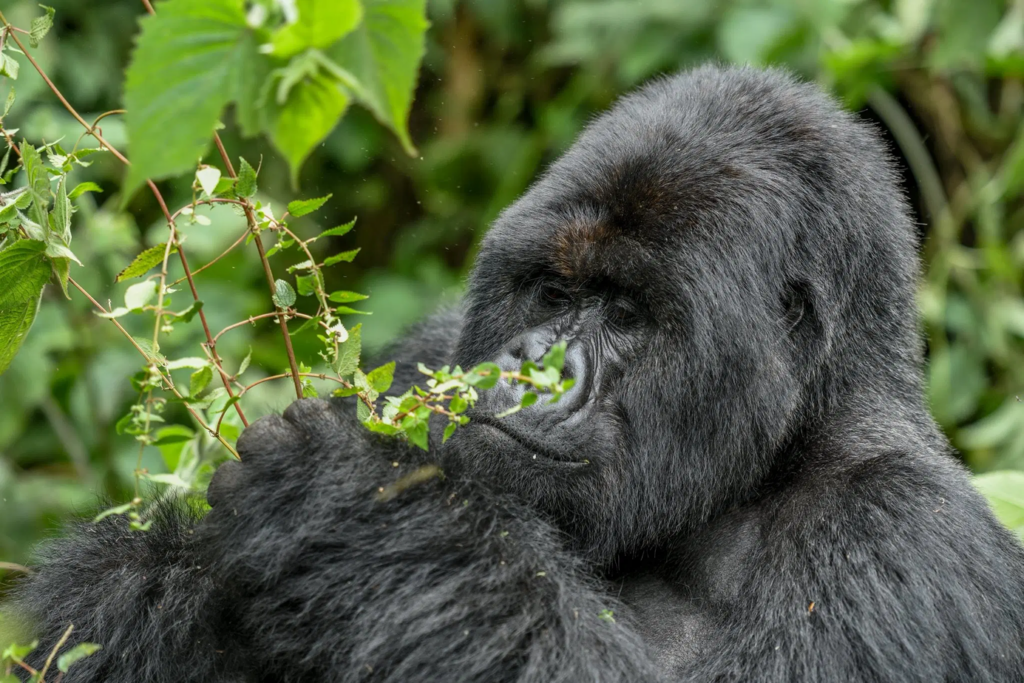 You stop. And there, close enough to hear breathing, a family of mountain gorillas goes about their morning. A mother nurses her infant. Two youngsters wrestle in the undergrowth. A silverback raises his head, regards you with ancient, intelligent eyes, and returns to his breakfast. You are sharing space with our closest wild relatives, and every cell in your body knows it.
But Volcanoes is not only gorillas. The golden monkey, flame-faced, acrobatic, and found naturally in only the Virunga volcanoes, leaps through bamboo groves with an energy that makes everyone around it smile involuntarily.
Hiking to the summit of Mount Bisoke rewards the willing with a crater lake of impossible blue, sitting at 3,711 meters above sea level. The tomb of Dian Fossey, resting beside her beloved gorilla Digit on the Karisoke Research Station grounds, is a pilgrimage that reminds you that conservation is not abstract, it is personal, it is costly, and it is worth it.
Over 200 bird species fill the park's altitude zones, including 29 endemic to the Virunga and Rwenzori regions. The park is one of Africa's oldest, gazetted in 1925, and carries the weight of that history in every ancient tree and every mist-soaked morning.
Rwanda has built something remarkable here, a model of conservation tourism that the entire world studies and admires. Permit fees fund anti-poaching patrols, ranger salaries, and community development programs that have turned local people from potential poachers into the gorillas' most passionate protectors. When you buy a permit, you are not just buying an experience. You are funding a future.
Wildlife
- Elephant
- Gorilla
- Vulture
- African Fish Eagle
- Hornbill
- Crowned Crane
- Bushbuck
- Baboon
- Colobus Monkey
- Mongoose
- Lilac-breasted Roller
- Weaver Bird
Gallery
Swipe to browse · tap to enlarge
Where To Stay
Five Volcanoes Boutique Hotel
Volcanoes National Park.
View DetailsKivu Serena Hotel
Volcanoes National Park
View DetailsCleo Lake Kivu Hotel
Volcanoes National Park
View DetailsWilderness Sabinyo
Volcanoes National Park.
View DetailsAmarembo Gorilla by Touch down
Volcanoes National Park
View DetailsAmakoro Songa Lodge
Volcanoes National Park
View Details